
What School Business Officials Should Know About Self-Insured Medical Reimbursement Plans (SIMRPs)
School business officials are increasingly encountering discussions about Self-Insured Medical Reimbursement Plans (SIMRPs), yet many remain unfamiliar with how these plans work or the federal tax framework that supports them.
CHIEF EXECUTIVE OFFICERECFOSUPERINTENDENTHEALTH CARETAX SAVINGSEMPLOYEE BENEFITS
Jake Parvu
7/10/20262 min read
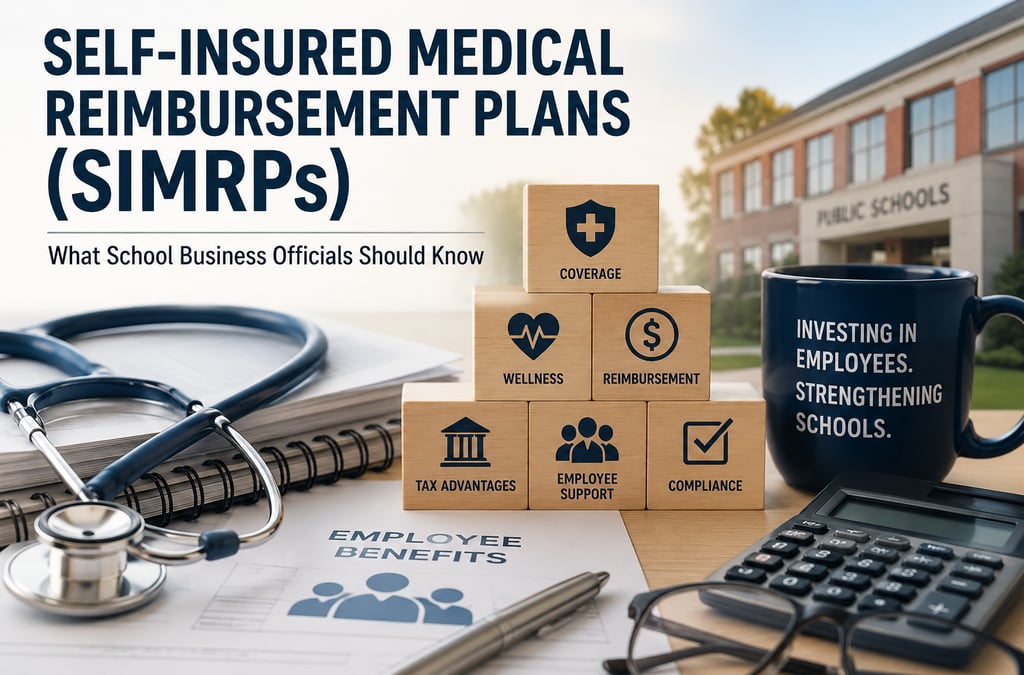
What School Business Officials Should Know About Self-Insured Medical Reimbursement Plans (SIMRPs)
IRS code-compliant employee benefit strategies for public-sector employers.
School business officials routinely evaluate new ideas intended to improve district operations, strengthen employee benefits, or create financial efficiencies. While some concepts are familiar, others represent approaches that many school leaders have never encountered. One employee benefit strategy that is beginning to appear in conversations across both the public and private sectors is the Self-Insured Medical Reimbursement Plan (SIMRP).
Although SIMRPs have existed for many years, they remain unfamiliar to many school business officials. As districts continue balancing workforce challenges, rising healthcare costs, and budget constraints, understanding how these plans work—and the questions they should ask when evaluating one—has become increasingly important.
A SIMRP is an employer-sponsored employee benefit arrangement that reimburses qualified medical expenses while providing access to wellness-related services. Unlike traditional health insurance, a SIMRP is not intended to replace a district's existing medical plan. Instead, it operates alongside employer-sponsored health coverage.
Most SIMRPs are structured using long-established provisions of the Internal Revenue Code, including Sections 105, 106, and 125, together with the definition of qualified medical expenses contained in Section 213(d). These provisions have served as the legal framework for employer-sponsored medical reimbursement arrangements for decades.
When properly designed and administered, a SIMRP may allow qualifying employee benefit contributions and reimbursements to receive favorable tax treatment under existing federal law. Depending on the specific plan design, participating employees may also receive access to wellness resources such as telehealth, mental health support, preventive care, prescription services, health coaching, and other health-related services.
School districts are taking a closer look at SIMRPs because they address several challenges simultaneously. Employees continue to experience financial pressure from rising living expenses and healthcare costs, while districts are working to recruit and retain qualified staff within limited budgets. Rather than replacing salaries or health insurance, a SIMRP is designed to enhance the overall value of an employee's compensation package through benefit design and tax-efficient reimbursement structures.
Like any employee benefit strategy, however, a SIMRP should be evaluated carefully. School business officials should understand the legal framework supporting the plan, review projected financial assumptions, determine who is responsible for administration, and seek independent legal and tax review before implementation. Questions about employee communication, payroll integration, compliance responsibilities, and ongoing administration are equally important.
One of the greatest strengths of a thoughtful evaluation process is that it allows district leaders to separate the concept itself from the organization presenting it. Regardless of who introduces a SIMRP, school business officials should expect clear documentation, transparent financial assumptions, qualified professional oversight, and straightforward answers to difficult questions.
Employee benefit strategies continue to evolve, and school districts will likely encounter new approaches in the years ahead. Whether a district ultimately determines that a Self-Insured Medical Reimbursement Plan is appropriate depends on its unique circumstances, goals, legal review, and financial analysis. Understanding how these plans work equips school business officials to ask informed questions, evaluate proposals responsibly, and make decisions that support both their employees and their district.
###
Jake Parvu is an employee benefits educator and public-sector benefits consultant specializing in IRS code-compliant employee benefit strategies. He works with school districts and other public & private sector employers to help leadership teams understand code compliant employee benefits, preventive wellness, and enrollment communication through educational presentations and resources.
Contact Us


Reach out to us for innovative scholarship and wellness solutions tailored for your business or school district. It would be an honor to assist you!
Copyright © 2024-2026 SIMRP Health & Wellness™. All rights reserved. | Privacy
Legal
Contact
Resources
Offices / Location
Rutherfordton, NC
SIMRP Health & Wellness™ is an independent entity that provide access to educational information regarding programs utilizing federally recognized tax codes and wellness reimbursement structures that may help qualifying organizations obtain benefits through payroll tax savings. We utilize the professional services of third-party providers for the preparation, filing, and implementation of SIMRP plan documents; however, we are not owned by, affiliated with, endorsed by, or acting on behalf of such providers, the Internal Revenue Service, the U.S. Department of Labor, or the federal government. The information provided on this website is for general educational and informational purposes only and should not be construed as tax, legal, accounting, financial, or regulatory advice. We are not tax professionals, attorneys, certified public accountants, or experts in the interpretation of tax law, and we do not recommend tax strategies or make guarantees regarding tax treatment, eligibility, savings, or compliance outcomes. Individuals and organizations seeking to verify or rely upon any information presented on this website should consult with qualified tax professionals, legal counsel, payroll specialists, or other licensed advisors regarding their specific circumstances before making any financial, tax-related, legal, or benefits decisions.